April 30, 2026 · 8 min read
Exotic Vet Near Pasadena: Birds, Rabbits, Reptiles, and Small Mammals
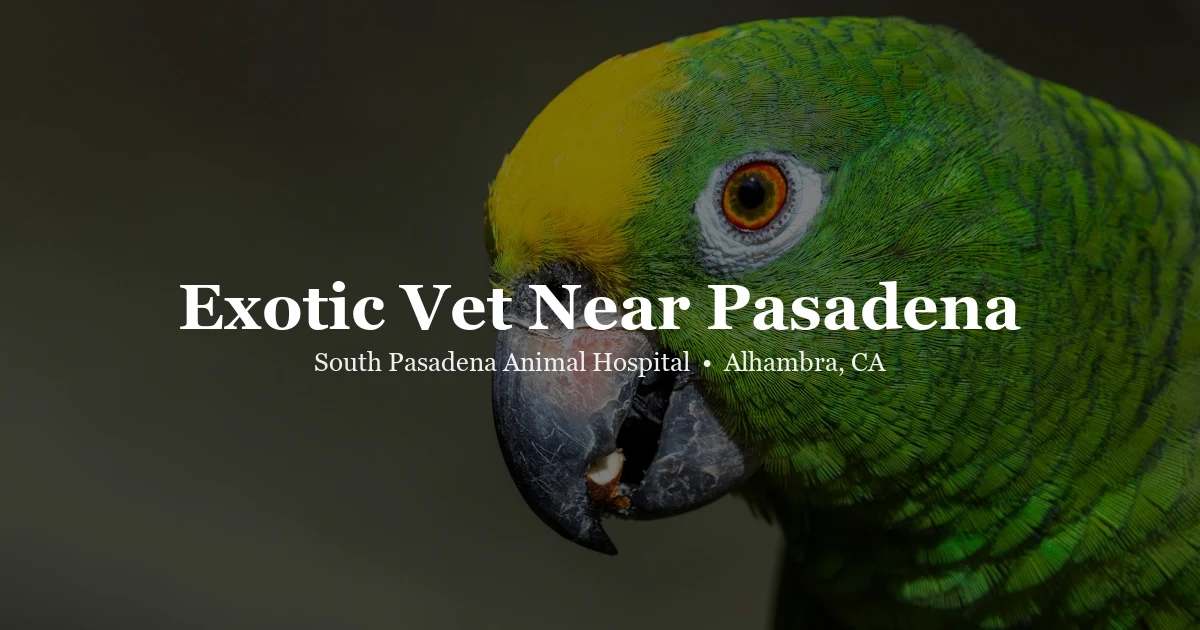
Pasadena has a solid number of veterinary clinics — but most of them are built around dogs and cats. If you have a parrot, rabbit, bearded dragon, guinea pig, or chinchilla, the honest answer at most of those clinics is that they can't help you, or they can help you only in the most general sense. Exotic animals — meaning any pet that is not a dog or cat — require a different kind of veterinary care, and that care is not uniformly available in the area.
South Pasadena Animal Hospital is 10 minutes from Pasadena via the 210 East or surface streets through San Marino and South Pasadena. We are at 3116 W Main St, Alhambra, CA 91801, and we see birds, rabbits, reptiles, guinea pigs, chinchillas, hamsters, and more. For general veterinary care near Pasadena, see our Pasadena page. This post explains what makes exotic vet care different and what Pasadena-area exotic pet owners can expect when they come to us.
To go straight to booking, visit our Pasadena exotic vet page or our Pasadena vet page. You can also call (626) 441-1314.
What makes an exotic vet different
The term "exotic vet" is sometimes used loosely, and it is worth being precise. A vet who "sees exotics occasionally" is meaningfully different from a vet who sees exotic animals as a regular, significant part of their caseload. Here is what that difference looks like in practice:
Species-specific physiology. Every class of exotic animal has physiological characteristics that differ fundamentally from dogs and cats. Birds are ectothermic in their evolutionary history but warm-blooded with a unique respiratory system built around air sacs. Rabbits have continuous-growth teeth and a digestive system that requires constant gut motility. Reptiles are truly ectothermic, with metabolic rates that change with environmental temperature. Guinea pigs cannot synthesize vitamin C. Chinchillas have continuously-growing teeth and are prone to dental disease that presents differently from rodents. Each species has its own normal blood values, its own medication sensitivities, and its own disease patterns. Veterinary training in dogs and cats does not automatically confer this knowledge.
Different diagnostic approaches. Diagnosing illness in a rabbit is not the same process as diagnosing illness in a dog. Exotic animals often require sedation or anesthesia for even basic diagnostic procedures — a bird cannot hold still for a meaningful oral exam without restraint, and a conscious rabbit cannot have its molar teeth properly assessed. In-house bloodwork, radiographs, and fecal analysis all require species-specific interpretation that is only reliable with regular exposure to these patients.
Different medications. Several antibiotics commonly used in dogs and cats are dangerous or fatal to certain exotic species. Penicillin, amoxicillin, and related antibiotics disrupt the gut flora of rabbits and guinea pigs in ways that can be lethal. Many compounds safe in mammals are toxic to birds. Dosing across exotic species spans multiple orders of magnitude in body weight. Getting medication selection and dosing right requires the kind of familiarity that comes from seeing these patients regularly.
Different handling. Improper handling causes significant stress in exotic animals — and stress in already-ill exotic animals can be life-threatening. A bird that is roughly restrained can die from capture myopathy (stress-induced muscle breakdown). A rabbit that struggles against restraint can fracture its own spine. Appropriate handling for each species requires practiced technique that is specific to that animal.
This is why "sees exotics occasionally" is not the same as seeing them regularly. The depth of knowledge required for competent exotic animal care is not trivial.
Birds we see near Pasadena
We see a broad range of pet bird species including parrots (African Greys, Amazon parrots, cockatoos, conures of various species, and macaws), cockatiels, parakeets and budgerigars, canaries, finches, lovebirds, and doves.
Common reasons Pasadena-area bird owners come to us include:
- Avian wellness exams — annual weight checks, feather assessment, vent and nares evaluation, husbandry review
- Feather destructive behavior — a complex condition with medical and behavioral components, common in psittacines
- Respiratory problems — nasal discharge, tail bobbing, open-mouth breathing, wheezing
- Beak and nail trimming — overgrown beaks can indicate nutritional or liver problems and need veterinary evaluation, not just trimming
- Egg binding in female birds — a reproductive emergency requiring same-day attention
Birds hide illness until they cannot, which means by the time visible signs appear, the disease is often advanced. Annual wellness visits are the most effective way to catch problems early. If your bird is showing any signs of illness — puffed feathers, tail bobbing, not eating, sitting on the cage floor — call us the same day.
Rabbits near Pasadena
Rabbits are one of the most commonly owned exotic pets in the United States, and one of the most frequently undertreated from a veterinary standpoint. Most rabbit owners in Pasadena have difficulty finding a vet who sees them regularly and who is prepared for the full scope of rabbit health issues.
We see rabbits for:
- GI stasis — when the gut slows or stops, rabbits deteriorate quickly. Not eating for 6+ hours, no droppings, teeth grinding, and hunched posture are signs that require same-day veterinary attention
- Dental disease — the leading cause of chronic illness and death in pet rabbits. Molar spurs are invisible to the owner but cause significant pain and weight loss. Annual dental checks require sedation to do properly
- Spay and neuter — unspayed female rabbits have up to an 80% lifetime risk of uterine adenocarcinoma. Spaying between 4 and 6 months eliminates this risk entirely. Rabbit anesthesia requires specific protocols that differ from dogs and cats
- Respiratory infections, head tilt, sore hocks, and ear mites
Rabbit-safe antibiotics are not the same as dog-and-cat antibiotics. Penicillin-class drugs, which are standard in many veterinary settings, are potentially fatal to rabbits due to disruption of gut flora. Knowing which antibiotics are appropriate for rabbits is not optional knowledge — it is basic rabbit medicine.
Reptiles near Pasadena
We see a range of reptile species including bearded dragons, leopard geckos, crested geckos, ball pythons, and tortoises. Reptiles are ectotherms — their body temperature, immune function, digestion, and metabolic rate all depend on their environmental temperature. Getting husbandry right is foundational to reptile health, and we review it at every visit.
Common reptile presentations include:
- Metabolic bone disease (MBD) — caused by inadequate UVB lighting and dietary calcium, causing soft and deformed bones. Largely preventable with proper husbandry; difficult to reverse once established
- Internal parasites — pinworms and coccidia are common in bearded dragons; routine fecal screening is part of wellness care
- Respiratory infections — bacterial respiratory infections triggered by inappropriate temperatures or humidity
- Impaction — intestinal blockage from ingested substrate, a serious and potentially fatal condition
- Dysecdysis (stuck shed) — retained shed on toes, tail tip, or eye caps can cause circulation problems and corneal damage
Tortoises warrant specific mention. Russian tortoises, red-footed tortoises, sulcata tortoises, and Hermann's tortoises all have slightly different husbandry requirements and health concerns. Hibernation (brumation) in tortoises carries real risks if the animal is not in optimal health beforehand. We can assess your tortoise's condition before and after brumation and advise on appropriate protocols.
Small mammals near Pasadena
We see guinea pigs, chinchillas, hamsters, and rats. Each has its own set of health considerations:
Guinea pigs require vitamin C daily (they cannot synthesize it), have continuously growing teeth prone to molar spurs, and are susceptible to upper respiratory infections that progress quickly. Annual dental checks and weight monitoring are the cornerstone of guinea pig wellness care.
Chinchillas also have continuously growing teeth, making dental disease a primary health concern. They have very dense, delicate fur and are sensitive to heat — temperatures above 75°F can cause heat stroke in chinchillas, which is a genuine veterinary emergency. Dental disease in chinchillas progresses differently from guinea pigs and requires an experienced eye to catch early.
Hamsters are short-lived (2–3 years) but prone to wet tail (proliferative ileitis), dental problems, skin conditions, and tumors in older animals. Because of their short lifespan, annual wellness visits are particularly important for catching conditions while they are still addressable.
Rats are highly social and intelligent, but prone to respiratory infections (mycoplasma is nearly ubiquitous in the rat population), tumors — particularly mammary tumors in females — and hind limb degeneration in older animals. Spaying female rats early significantly reduces the risk of mammary tumor development.
In-house diagnostics for exotic animals
One of the practical limitations of seeking exotic care at a general practice that "occasionally sees exotics" is that their diagnostic capabilities may not extend meaningfully to exotic animals. We have in-house diagnostic capabilities that we apply to exotic patients, not just dogs and cats:
Bloodwork. Complete blood count and chemistry panels for exotic animals — with interpretation against species-appropriate reference ranges. Blood sampling in small exotic animals requires appropriate technique and equipment; too large a sample from a small bird or guinea pig can cause significant harm.
Radiographs (X-rays). Whole-body radiographs are essential for diagnosing GI stasis in rabbits, bladder stones in guinea pigs, metabolic bone disease in reptiles, respiratory disease in birds, and many other conditions. Positioning and technique for small exotic animals differ from dogs and cats.
Fecal analysis. Fecal float and direct smear for parasite screening — important for rabbits, guinea pigs, reptiles, and birds. Parasite burden that is subclinical in a healthy animal can become disease-causing under stress or when immunity is compromised.
Cytology and cultures. Impression smears, ear cytology, skin scrapes, and bacterial cultures when appropriate. Identifying the causative organism is important for selecting the right antibiotic, particularly in exotic animals where the wrong antibiotic can cause harm.
Having these capabilities in-house — rather than sending samples to an outside lab with a 24–48 hour turnaround — matters when a rabbit has been in GI stasis since this morning or a bearded dragon has been not eating for three weeks.
Getting to us from Pasadena
From central Pasadena — Old Town, the Caltech area, or the Colorado Boulevard corridor — the most direct route is the 210 East to the Fremont Avenue exit, then south through South Pasadena to Main Street and west to our location. Via surface streets, heading south through San Marino on Huntington Drive or California Boulevard and then west on Main Street also works well.
Total drive time from most parts of Pasadena is approximately 10 minutes, depending on traffic. We are at 3116 W Main St, Alhambra, CA 91801, with parking directly in front of the clinic.
We also serve exotic pet owners from Pasadena, San Marino, South Pasadena, Arcadia, and surrounding communities.
To book an exotic pet wellness exam or report a health concern, visit our Pasadena exotic vet page, our services page, our contact page, or call (626) 441-1314. If your exotic pet is showing urgent signs — not eating, difficulty breathing, neurological symptoms, or any other acute change — please call rather than booking online. We can help you assess urgency and determine whether your pet needs to be seen the same day.
Questions we hear often from Pasadena exotic pet owners
How far is South Pasadena Animal Hospital from Pasadena?
We are at 3116 W Main St, Alhambra, CA 91801 — approximately 10 minutes from central Pasadena via the 210 East or surface streets through San Marino and South Pasadena. Parking is directly in front of the clinic. Call (626) 441-1314 for directions from your specific location.
What exotic animals does South Pasadena Animal Hospital see?
We see birds (parrots, cockatiels, conures, finches, lovebirds, doves), rabbits, reptiles (bearded dragons, geckos, ball pythons, tortoises), guinea pigs, chinchillas, hamsters, and rats. Call (626) 441-1314 if your pet is not listed — we can confirm whether we are able to see them.
Do you take same-day urgent appointments for exotic animals?
We do our best to accommodate same-day urgent care when availability allows. Exotic animals can deteriorate quickly once they stop masking illness — call us at (626) 441-1314 as soon as you notice concerning signs. We can advise on urgency and whether your pet needs to be seen immediately.
How should I prepare my exotic pet for travel to the vet?
Use a secure, ventilated carrier. Cover a bird carrier with a light cloth to reduce visual stress. Include familiar bedding and hay for rabbits and guinea pigs. For reptiles, keep the carrier warm on cold days. Minimize travel time. Rabbits and guinea pigs should have access to hay even during short trips. Contact us with any questions about preparing your specific pet for the visit.