May 4, 2026 · 7 min read
Cat Dental Disease in Alhambra: Signs, Cleaning, and What Owners Miss
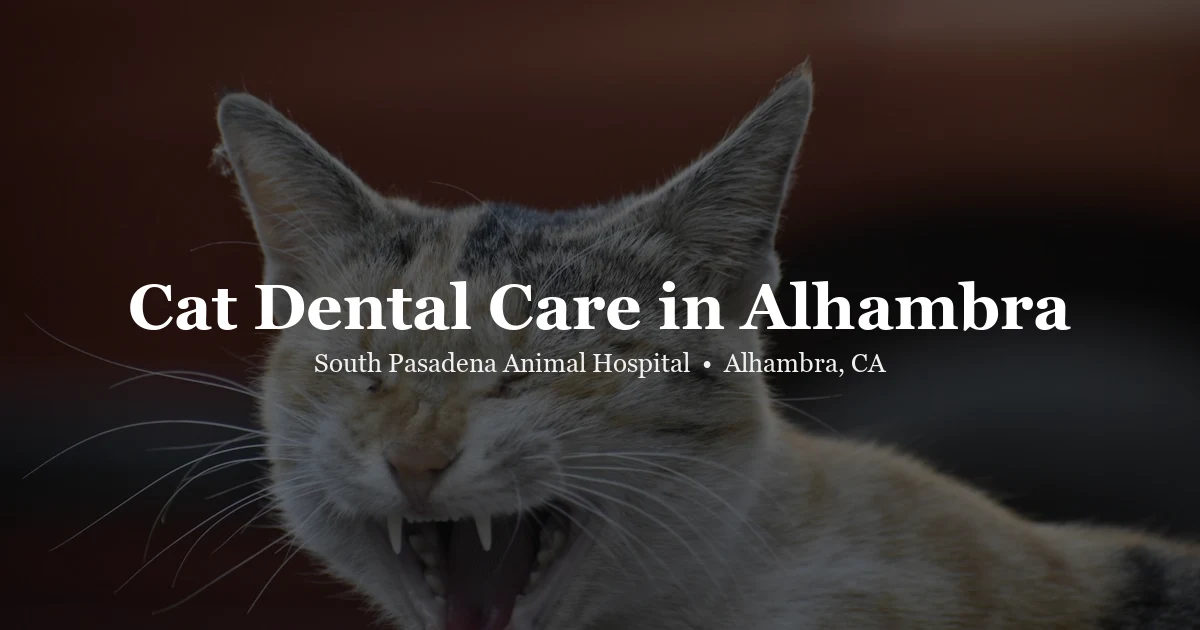
Dental disease doesn't announce itself in cats. Not usually. A dog with a sore tooth might paw at its face, whimper, stop eating — cats don't do that. Instead they quietly shift to chewing on the other side. Start preferring wet food. Stop grooming as thoroughly. By the time an owner notices something's off, the problem has often been brewing for months.
We do dental assessments at every wellness exam at South Pasadena Animal Hospital in Alhambra, and we see dental disease all the time — in cats owners describe as completely healthy. Here's what to actually know about it.
Why cats hide dental pain
The short version: instinct. An animal that stops eating in the wild doesn't survive. So cats suppress the outward signs of pain and keep going, even when their mouths hurt. This isn't stubbornness — it's a hard-wired pattern that makes them genuinely difficult to read.
What they do instead is adapt. Chew only on the side that doesn't hurt. Swallow food without chewing much. Avoid hard kibble. Become less tolerant when you touch their face. None of these ring alarm bells for most owners. And yet every one of them is a signal. This is why we look — because your cat isn't going to tell you.
The stages of feline dental disease
Four stages. The difference between stage 1 and stage 4 is significant.
Stage 1: plaque and early tartar, gums slightly inflamed — still reversible; a thorough cleaning at this stage gets you back to baseline. Stage 2: gum recession begins, bacteria accumulating below the gumline, some bone loss started — treatable, but not fully reversible anymore. Stages 3–4: significant bone loss, mobile teeth, potential abscess formation, extractions usually necessary. At this point, bacteria from the mouth have been entering the bloodstream chronically — that exposure affects the heart, kidneys, and liver over time.
Most cats we see for a first dental assessment are already at stage 2 or 3. Owners are often surprised. The cat didn't seem painful. That's the point.
Tooth resorption: the cat-specific problem
Tooth resorption is probably the dental condition we see most frequently in cats — and the one most owners have never heard of. The body breaks down its own tooth structure, starting at the root and working outward. The tooth dissolves. Eventually the crown erodes and the root fuses with the bone. It's extremely painful in the active phases.
Sometimes you can see it: a pink or reddish notch at the gumline where enamel has eroded. Often there's nothing visible from the outside at all. Dental X-rays are the only way to diagnose it — which is why full-mouth X-rays are a standard part of a cleaning here, not an optional extra.
The treatment is extraction. And here's what we see over and over afterward: owners come back and say the cat is acting like a kitten again. More playful, more interactive, eating with enthusiasm. The cat had been masking significant chronic pain. They didn't know it until the source was gone.
Signs of dental disease in cats
Some are obvious. A lot aren't:
Signs that are worth a dental exam: bad breath that’s persistent, not just after eating fish; yellow or brown buildup along the gumline; gums that look red, swollen, or bleed when touched; drooling occasionally with a little blood; pawing at the mouth or rubbing the face; chewing exclusively on one side.
If your cat has three or more of these, come in. If it's one or two, mention it at the next wellness exam. Not sure? Call us at (626) 441-1314 and describe what you're seeing.
What a professional dental cleaning at SPAH involves
A real dental cleaning requires general anesthesia. This isn't about making things easier — it's the only way to do it properly. Scaling below the gumline, probing each individual tooth, taking full-mouth X-rays, treating what we find — none of this is possible or safe in an awake cat. Anesthesia-free dentals sold at groomers or pet stores clean visible surface tartar only. That's like scrubbing the outside of your own teeth and skipping everything underneath. The disease lives below the gumline.
What we do at a SPAH dental cleaning:
What a cat dental actually involves: pre-anesthetic bloodwork to check kidney and liver function before anesthesia, standard for every patient and especially cats over 7. IV catheter and fluids to support blood pressure and provide immediate IV access. Full-mouth dental X-rays showing roots, bone levels, resorption, and retained roots — we don’t skip these because the surface exam misses most of what matters. Ultrasonic scaling and polishing, above and below the gumline. Periodontal probing of every individual tooth. Extractions of diseased, resorbing, or infected teeth with sutured closure. And pain management — local nerve blocks during the procedure, take-home medication when appropriate.
Recovery is usually quick. Most cats are eating normally that evening or the next day. Multiple extractions? We recommend soft food for a few days while the gum tissue heals.
How often do cats need dental cleanings?
It varies. Some cats build tartar fast and need a cleaning every year. Others can go 18 months to two years without things progressing significantly. We assess dental health at every wellness exam and give you a recommendation based on what we see — not a blanket schedule. Our pricing page has dental cleaning fees listed.
Home dental care for cats
Daily brushing with a pet-safe toothpaste is the most effective at-home option. Getting there takes patience — start with letting the cat taste the toothpaste, then a finger brush, then a small brush. Most cats introduced slowly will tolerate it. Older cats are harder but not impossible.
Dental chews, water additives, and dental diet formulas can reduce plaque accumulation — they're useful additions, but they don't substitute for professional cleanings. Ask us what's realistic for your specific cat.
Questions about cat dental care in Alhambra
How do I know if my cat has dental disease?
Common signs include bad breath, red gums, tartar buildup, drooling, pawing at the mouth, preference for soft food, and chewing on one side. Many cats show minimal signs — a vet dental assessment at each wellness exam is the most reliable way to catch problems early.
Does my cat need anesthesia for a dental cleaning?
Yes. Proper dental care requires anesthesia to scale below the gumline, take X-rays, probe each tooth, and safely treat any problems found. Anesthesia-free dentals only clean visible surface tartar and don't address disease where it actually develops.
What is tooth resorption in cats?
Tooth resorption is a painful condition where the tooth structure breaks down from the inside, starting at the root. It's very common in adult cats and is diagnosed with dental X-rays. The treatment is extraction of the affected tooth.
How often does my cat need a dental cleaning?
Every 1–2 years for most cats, depending on how quickly tartar builds up. We assess dental health at every wellness exam and recommend timing based on what we find.
Can I get my cat's teeth cleaned at SPAH in Alhambra?
Yes. We perform professional dental cleanings under general anesthesia with pre-anesthetic bloodwork included. Book online or call (626) 441-1314. We're at 3116 W Main St, Alhambra, CA 91801.