April 11, 2026 · 8 min read
Senior Dogs in Alhambra: When to Visit the Vet More Often — and Why It Matters ❤️
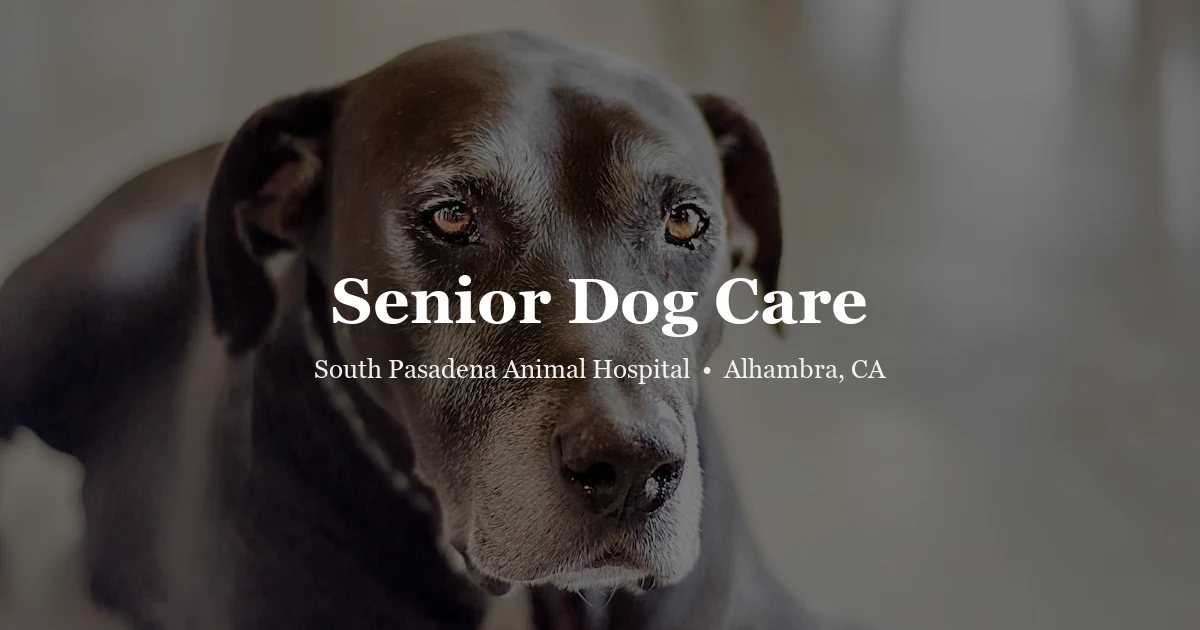
There's a specific kind of heartbreak that happens when you bring in a dog who's been "slowing down a little" and we find something that's been building for months. Kidney disease, an undetected tumor, dental infections so advanced the teeth are barely holding on. And when we ask how long it's been going on, the answer is almost always the same: "We thought it was just age."
This post is for the owners of dogs who are 7 and older. Because the standard once-a-year visit isn't enough anymore, and we want to explain exactly why.
When Is a Dog Considered "Senior"?
It depends on size. Large and giant breeds age faster than small breeds:
- Small breeds (under 20 lbs): Senior at around 10–12 years
- Medium breeds (20–50 lbs): Senior at around 8–10 years
- Large breeds (50–90 lbs): Senior at around 7–8 years
- Giant breeds (over 90 lbs): Senior at around 5–6 years
A seven-year-old Golden Retriever is in a very different life stage than a seven-year-old Chihuahua. We factor this into how we talk about wellness schedules with our Alhambra dog patients.
Why Twice a Year?
In human terms, once a year for a senior dog is roughly equivalent to a person going to the doctor once every 4–7 years. A lot can change in six months for an aging dog — kidney values that were borderline can cross into treatment-needed range. A heart murmur that was grade 2 in April can be grade 4 by October. Dental disease that was "something to watch" can become a jaw infection.
Twice-yearly exams give us the comparison point we need. We're not just looking at your dog in isolation — we're comparing them to themselves six months ago. That trend line tells us far more than a single snapshot.
Senior Bloodwork: What We're Actually Looking For
We recommend a senior blood panel — CBC plus comprehensive chemistry — at least once a year, ideally twice. Kidney values catch kidney disease before it's visible, and that matters because by the time a dog is drinking more, losing weight, or vomiting, significant function is already gone; early detection here meaningfully extends comfortable life. Liver values can flag liver disease, Cushing's, or medication effects before any clinical sign shows up. Thyroid levels catch hypothyroidism, which is common in middle-aged and older dogs and causes weight gain, lethargy, and skin problems — completely manageable with a daily pill once we know it's there. Blood sugar catches diabetes early enough that diet management alone sometimes delays the need for insulin. And the red and white cell counts flag anemia, infection, or immune issues well before you'd notice anything at home.
Arthritis: The Condition We Under-Diagnose in Dogs
Dogs are extremely good at hiding pain. It's evolutionary — showing weakness in the wild is dangerous. So they compensate, adjust, slow down gradually, and their owners often don't notice until things are quite advanced.
The signs of arthritis are easy to write off as just getting old: taking longer to get up from lying down, reluctance to climb stairs or jump into the car or hop onto furniture they used to love, walking more slowly on longer routes that you might mistake for mellowing out, licking or chewing at joints — especially hips and elbows — and a slight morning stiffness that loosens up once they're moving.
If any of those sound familiar, come in. There are good options now — joint supplements, anti-inflammatory medications, weight management, laser therapy — and none of them work as well when we wait until the dog is visibly struggling.
Dental Disease Gets Worse With Age
By age seven, most dogs have significant dental disease — tartar buildup, gum inflammation, root exposure. The same bacteria causing infection in the mouth are circulating through the bloodstream and affecting the heart, kidneys, and liver. This isn't a cosmetic issue. We do a dental exam at every wellness visit specifically because we know how quickly things can escalate in older dogs.
If your dog has noticeably bad breath, is dropping food, chewing on one side, or pawing at their mouth — that's dental pain. We want to see them sooner rather than later.
Weight Changes in Either Direction
Weight gain in an older dog (especially combined with lethargy and hair loss) can signal hypothyroidism or Cushing's. Weight loss in an older dog — especially if appetite is normal or increased — can mean diabetes, kidney disease, cancer, or hyperthyroidism (less common in dogs than cats, but it happens). Either direction warrants a conversation.
We track weight at every visit. It's one of the most useful data points we have over time.
The Honest Conversation About "What's Worth Treating"
We know that as dogs get older, the question of how much to intervene gets harder. There's a real difference between treating an 8-year-old Labrador who has 4–6 comfortable years ahead of them and an aggressive tumor surgery on a 15-year-old Chihuahua with multiple organ disease. We have these conversations every day, and we don't push treatment for its own sake.
What we do push for is information. Knowing what's going on means you get to make an informed choice about what to do. Coming in twice a year doesn't lock you into any particular treatment plan — it just means you're not making decisions in the dark.
We see senior dogs from all across Alhambra, South Pasadena, Pasadena, and the San Gabriel Valley. Our clinic is at 3116 W Main St. Book a senior wellness exam online or call (626) 441-1314. Bring their record if you have it — we'll do the rest.
Frequently Asked Questions
When is a dog considered a senior?
It depends on size. Small breeds (under 20 lbs) don't typically enter their senior years until around 10–12, while giant breeds can be considered senior as early as 5–6 years old. A seven-year-old Great Dane is in a very different life stage than a seven-year-old Dachshund. We take breed and body size into account when we talk about wellness schedules — there's no single age that applies to every dog.
How often should a senior dog see the vet?
Twice a year is our recommendation for dogs over 7, and the reasoning is straightforward: in human terms, a year in a senior dog's life is roughly equivalent to 4–7 human years. A lot can change in six months — kidney values that were borderline can cross into treatment-needed range, a grade 2 heart murmur can become a grade 4, dental disease can progress from "something to watch" to a jaw infection. Twice-yearly visits give us a comparison point so we're tracking trends, not just snapshots.
What does senior bloodwork actually check for?
A senior blood panel typically looks at kidney function, liver values, thyroid levels, blood sugar, and complete blood cell counts. Kidney disease is one of the most common findings in older dogs — and one of the most important to catch early, because significant function is already lost by the time symptoms appear. Thyroid issues, early diabetes, and anemia can also be identified before they cause obvious clinical signs. Catching these things early gives us real options. By the time the dog is visibly symptomatic, the options narrow.
My older dog is slowing down. Is that just age, or should I have it checked?
We hear this a lot, and our honest answer is: have it checked. "Slowing down" is one of the most common presentations for arthritis, hypothyroidism, heart disease, kidney disease, and anemia in older dogs — none of which are just normal aging, and all of which are manageable when found early. Dogs are very good at compensating and hiding discomfort. By the time you notice the slowdown, things may have been building for months. An exam and bloodwork can tell you what you're actually dealing with.
Is it worth treating health problems in a very old dog?
This is one of the most personal conversations we have at our clinic, and there's no universal right answer. What we can say is that "treating" doesn't always mean aggressive intervention. For many senior dogs, managing a chronic condition — arthritis, kidney disease, hypothyroidism — means better quality of life for months or years, not just prolonging things at the end. We approach these conversations honestly, without pushing treatment for its own sake. What we do advocate for is having the information. Knowing what's going on lets you make real choices instead of guessing.