April 9, 2026 · 9 min read
Cockatiel & Parakeet Care: What Most Owners Get Wrong 🦜
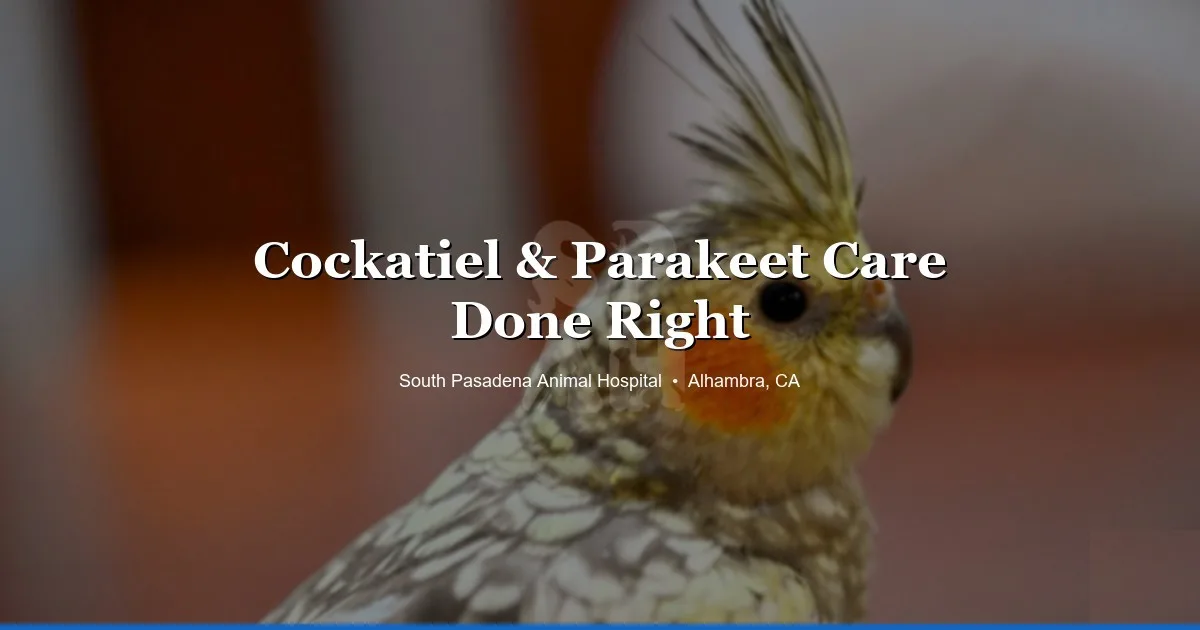
Here's the thing about cockatiels and budgies: they're so common that people forget they're complicated. You can buy a budgie at a pet store in Alhambra for $25. You can pick up a cockatiel in San Gabriel for $80. They come home, they sit on a perch, they chirp. Seems easy. And then three years in, something goes wrong and the owner realizes they've never once taken this bird to a vet.
We're not judging. It happens constantly. Cockatiels and parakeets are the most popular pet birds in the country, and they're also the ones with the biggest gap between what owners think they need and what they actually need. At South Pasadena Animal Hospital, a huge chunk of our avian appointments are cockatiels and budgies coming in for something that's been building for months.
So let's talk about what to actually watch for, what most people get wrong, and when to bring your bird in.
The Seed Diet Problem
This is the single biggest issue we see. It's not even close.
Most cockatiels and parakeets in the San Gabriel Valley are eating an all-seed diet because that's what the pet store sold with the bird. Seeds come in a pretty bag with a picture of a happy cockatiel on it. Seems legit. The bird eats them enthusiastically. Everyone's happy.
Except an all-seed diet for a cockatiel or budgie is like eating nothing but French fries for every meal. Seeds are high in fat, low in vitamins, and missing most of what these birds need. Fatty liver disease is the number one killer of budgies on bad diets. Vitamin A deficiency follows — respiratory problems, mouth sores, poor feather quality. Obesity is common, especially in cockatiels. And lifespan: a well-cared-for cockatiel can live 20+ years. On an all-seed diet? Often 8–12.
What they should be eating: a pellet-based diet (Harrison's, Roudybush, or similar) as 60-70% of their food, supplemented with fresh vegetables — dark leafy greens, carrots, sweet potato, bell peppers. Seeds as a treat, not a staple. Yes, the bird will resist the switch. They always do. It takes patience and persistence, sometimes weeks. But this single change adds years to their life.
If you're in Pasadena or Highland Park and your cockatiel has been on seeds for years, it's not too late to switch. But get a wellness exam first so we can check the liver and make sure there isn't damage we need to address while you transition the diet.
Respiratory Issues — The Silent Buildup
Birds have an incredibly efficient respiratory system — air sacs, flow-through ventilation, the whole setup. It's beautiful engineering. It also means they're extremely sensitive to airborne irritants that wouldn't bother a dog or cat.
Non-stick cookware fumes are the worst offender — Teflon and PTFE can kill a bird in minutes, and that's not an exaggeration. Scented candles, air fresheners, and incense cause problems too, along with cleaning products used near the cage, cigarette or vape smoke, and dusty rooms with poor ventilation. We've had owners in South Pasadena bring in a cockatiel with breathing problems and not connect it to the new Teflon pan they bought the week before. We've had budgies in Alhambra apartments come in wheezing because someone was burning incense in the same room every evening. The bird is that sensitive.
Tail bobbing — the tail moving up and down with each breath — is the sign we take most seriously; if you see it, come in. Open-mouth breathing, clicking or wheezing sounds, nasal discharge or crusty nostrils, and sneezing that's frequent rather than occasional all point the same direction.
Respiratory infections in small birds move fast. A cockatiel that seems a little off on Monday can be in serious trouble by Wednesday. Don't take a wait-and-see approach with breathing problems.
Night Frights — The Cockatiel Thing
This one is specific to cockatiels, and if you've owned one, you probably know exactly what we're talking about.
Middle of the night. Total darkness. Suddenly your cockatiel is thrashing wildly in the cage, wings hitting bars, feathers flying, total chaos. By the time you get the light on, the bird is panting on the bottom of the cage, maybe bleeding from a broken blood feather. That's a night fright.
Cockatiels are uniquely prone to these panic episodes. Something startles them — a car headlight through the window, a noise, a shadow — and because it's pitch dark, they can't orient themselves. They just thrash. And in a cage, thrashing means hitting metal bars, breaking feathers, sometimes worse.
A dim nightlight near the cage helps, so they can orient themselves if they wake up startled. A partial cage cover that blocks sudden light changes while still letting in some ambient light helps too, along with moving the cage away from windows where car headlights sweep through, and keeping it in a quieter room away from the TV or front door.
If your cockatiel has a night fright and breaks a blood feather, you may need to come in. A broken blood feather that won't stop bleeding is an emergency. Apply styptic powder or cornstarch and pressure first, but if the bleeding doesn't stop within a few minutes, call us.
The "My Bird Is Fine" Problem
This is the hardest conversation we have with bird owners, and we have it all the time.
Birds hide illness. This isn't a quirk — it's survival programming. In the wild, a sick bird that looks sick gets picked off by a predator or pushed out of the flock. So they fake it. They act normal, they eat (or pretend to eat), they sit on the perch looking perfectly fine. Until they can't anymore. And by that point, they've often been sick for weeks or months.
This is why we push for annual wellness exams for cockatiels and budgies, even when the owner says the bird is doing great. A physical exam and basic bloodwork catch things no owner could see from across the room — early liver changes from a seed-heavy diet, subclinical infections, weight loss hidden under feathers, crop or beak abnormalities.
We weigh every bird that comes in. Weight is one of the most useful data points we have, and most owners don't have a gram scale at home. A cockatiel that's dropped from 95 grams to 80 grams looks exactly the same to you. To us, that's a 15% loss and something is going on.
Egg Binding — Female Birds at Risk
If you have a female cockatiel or budgie, you need to know about this one. Birds can lay eggs without a male present — they'll be infertile, but the bird doesn't know that. Chronic egg-laying is common in pet cockatiels and budgies, especially ones that are over-bonded with their owner or getting too many daylight hours.
Egg binding is when an egg gets stuck. The bird is trying to pass the egg and can't. This is a genuine emergency — it can be fatal.
Watch for sitting fluffed up on the cage floor, visible straining to pass something, tail wagging or pumping, lethargy and not eating, and a swollen abdomen.
If your female bird is on the cage floor, fluffed, straining, and not acting right — don't wait until tomorrow. Call us. You can put her in a warm, humid environment (a steamy bathroom works as a first aid step) while you arrange to come in, but egg binding needs veterinary intervention.
Prevention: reduce daylight hours to 10-12 per day (cover the cage early), don't provide nesting material or enclosed spaces in the cage, don't pet your bird along the back (it triggers hormonal behavior), and make sure the diet includes adequate calcium. If your hen is laying eggs regularly, talk to us about a hormone implant that can slow it down.
Household Dangers Owners Don't Think About
Living in Alhambra or anywhere in the SGV with a bird means sharing a small indoor space where things harmless to humans can be lethal to a 90-gram cockatiel. Beyond the Teflon fumes we mentioned, ceiling fans are a hard no whenever the bird is out, no exceptions. Open windows and doors are riskier than people think — clipped wings don't guarantee a bird can't fly, and a good gust of wind can carry a clipped cockatiel out the door and over the neighbor's house before you blink; we've heard that story from owners in Highland Park, Pasadena, and San Gabriel more times than we'd like. Other pets matter too — cats are the obvious risk, but dogs as well, and one playful swat from a cat can introduce bacteria that kills a bird within 48 hours even if the wound looks minor. Avocado, chocolate, and caffeine are toxic and need to stay away from the bird entirely. And zinc and lead show up in older cages, zipper pulls, certain jewelry, and some bells — birds chew on everything, and heavy metal toxicity is a real diagnosis we've made more than once.
When to Wait vs. When to Come In
Small birds have fast metabolisms and not a lot of reserves. The window between "a little off" and "critical" is shorter than you think.
Slightly quieter than usual but still eating and drinking normally, one or two sneezes with no discharge, or a single loose dropping that resolves on its own — those are fine to watch for up to 24 hours. Fluffed up for extended periods, eating less for a full day, sitting on the cage floor instead of perching, feather quality declining, or persistent sneezing mean come in within a day. But tail bobbing or any labored breathing, not eating at all, sitting fluffed with eyes closing, bleeding that won't stop, signs of egg binding, exposure to Teflon fumes or smoke, or a bird found weak and unresponsive on the cage floor — those mean now, not later.
Finding a Bird Vet Near You
Most vet clinics in the San Gabriel Valley are set up for dogs and cats. Plenty of them will say they can see your bird, and some can — but there's a real difference between a clinic that sees three birds a year and one that sees them weekly.
We see cockatiels, parakeets, conures, African greys, and other birds regularly at our Alhambra clinic. Dr. Navia has a particular interest in avian medicine and sees the majority of our bird patients. If you're in South Pasadena, Pasadena, Highland Park, or San Gabriel and you've been looking for a vet who actually knows their way around a cockatiel — we're here.
Call us at (626) 441-1314 or book online. Bring your bird in for a wellness check, even if they seem fine. Especially if they seem fine.
Frequently Asked Questions
How often should a healthy cockatiel or parakeet see a vet?
An annual wellness exam is a good baseline for most healthy birds, though your vet may recommend more frequent visits depending on age or health history. Because birds hide illness so well, these checkups are often when problems get caught — long before the bird shows obvious symptoms at home.
My bird is puffed up and quiet — is that normal?
Occasional fluffing while resting can be normal, especially during sleep. But a bird that stays puffed up throughout the day, sits low on the perch, or seems unusually quiet compared to its normal self could be telling you something's wrong. Birds are prey animals and instinctively mask weakness, so any noticeable change in energy or posture is worth a call to your vet.
Is feather plucking always a medical problem?
Not always — feather plucking can stem from boredom, stress, or environment, but it can also be a sign of an underlying medical issue like skin irritation, pain, or a nutritional imbalance. Because the causes overlap so much, a vet visit is the best way to sort out which one you're dealing with rather than guessing.
What should I do if I think my bird ate something toxic?
Contact your vet right away rather than waiting to see if symptoms develop. Birds have fast metabolisms and can deteriorate quickly after exposure to things like Teflon fumes, certain houseplants, or chocolate. Bring any packaging or information about what was ingested with you if you can.
What's the best way to find a vet who treats birds?
Ask directly how often the clinic sees avian patients — many general practices will see birds occasionally but aren't set up for the specifics of avian care. A clinic that regularly sees cockatiels, parakeets, conures, and other birds will be more familiar with the subtle signs of illness that are easy to miss in these species.