April 11, 2026 · 8 min read
When to Spay or Neuter Your Dog — An Alhambra Vet's Honest Guide ⚙️
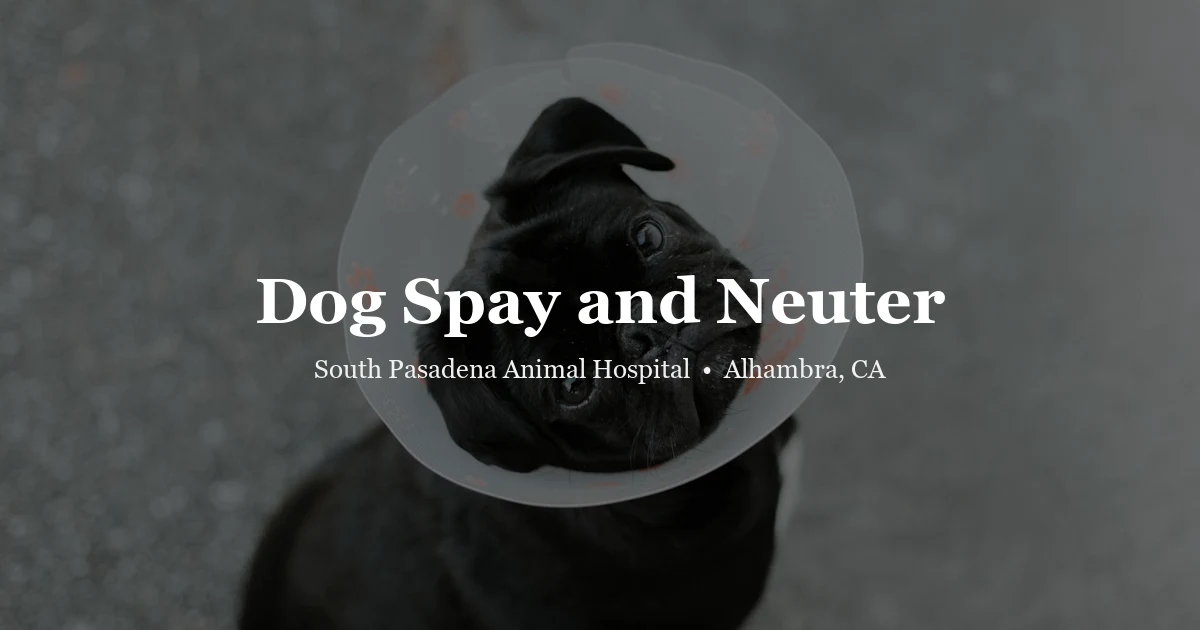
Ask three vets when to spay or neuter your dog and you might get three different answers. That's not because one of them is wrong — it's because the research has genuinely evolved, and the right answer depends on your specific dog. Here's where the science stands today and how we think about it at our Alhambra clinic.
Why the "6 Months" Rule Is Outdated (for Some Dogs)
The recommendation to spay or neuter at 6 months came largely from shelter medicine, where the goal was to prevent accidental litters before adoption. For small dogs and cats, it still makes sense. But for medium, large, and giant breeds, a growing body of research suggests that early spay/neuter — before growth plates close — may increase the risk of certain orthopedic problems and some hormone-sensitive cancers.
The hormones produced by the ovaries and testes play a role in musculoskeletal development. Remove them too early in a dog that's still actively growing, and the growth plates stay open longer, potentially affecting joint development. This effect is more pronounced in larger breeds that grow over a longer period.
Studies on Golden Retrievers, Labrador Retrievers, German Shepherds, and other large breeds have shown statistically significant associations between early neutering and higher rates of hip dysplasia, cranial cruciate ligament tears, and certain cancers. The same associations haven't been found consistently in small breeds.
General Guidelines by Size
- Small breeds (under 20 lbs): 5–6 months is appropriate. The hormonal benefits of waiting longer are minimal, and early spay in female dogs significantly reduces mammary tumor risk.
- Medium breeds (20–45 lbs): 6–12 months is a reasonable window. We'll discuss based on your dog's breed and individual development.
- Large breeds (45–90 lbs): 12–18 months for males; 6–12 months for females (earlier spay before first heat reduces mammary tumor risk significantly). The tradeoff between orthopedic risk and reproductive cancer risk is a real conversation worth having.
- Giant breeds (over 90 lbs): Many vets now recommend waiting until 18–24 months. The orthopedic risks of early neutering are most pronounced in dogs that take the longest to mature.
Female Dogs: The Heat Cycle Consideration
Spaying a female dog before her first heat cycle reduces her lifetime risk of mammary (breast) tumors to near zero. After one heat cycle, the risk rises to about 8%. After two heat cycles, it increases further. This is a strong argument for not waiting too long with female dogs, even larger ones.
First heat in small breeds typically occurs around 6 months. In large and giant breeds, it may not occur until 12–18 months. So for a large-breed female, there's often a natural window between 6–12 months where you can spay her before first heat while still allowing meaningful growth to occur.
If your female dog has her first heat before you get her spayed, that's okay — it's not an emergency, and the benefits of spaying still significantly outweigh not spaying. We'll talk through the timing with you.
Male Dogs: The Case for Waiting in Large Breeds
The primary arguments for neutering male dogs are behavioral (reducing roaming, marking, aggression, humping) and health-related (eliminating testicular cancer, reducing benign prostate enlargement risk). These are real benefits. But in large-breed males, the orthopedic data is compelling enough that many vets now recommend waiting until at least 12–18 months before neutering.
If intact-male behavior is a significant issue — persistent aggression, escape behavior, urine marking in the house — that's a quality-of-life issue that factors into the timing decision. We're not going to tell you to wait 18 months if your dog is making your household unmanageable. We'll find the right balance.
What About "Partial" Procedures?
Ovary-sparing spay (hysterectomy) and vasectomy in male dogs are procedures that prevent reproduction while leaving the hormone-producing organs in place. They're gaining more attention as the research on hormones and orthopedic health accumulates. They're not widely offered yet, and long-term data is still developing. If this interests you, bring it up — we're happy to have that conversation honestly.
The Bottom Line
There is no single right answer that applies to every dog. What we'll tell you at your appointment is this:
- For small dogs, 5–6 months is still a reasonable standard
- For large and giant breeds, we lean toward waiting — especially for males
- For females, we balance mammary tumor risk against orthopedic risk based on breed size and when first heat is expected
- Your lifestyle and your dog's individual behavior are part of the equation
If your dog is due for a wellness exam or you'd like to talk through the spay/neuter decision specifically, we're at 3116 W Main St in Alhambra. book a vet appointment or call (626) 441-1314. We'll look at your specific dog, not just give you a generic age.
Frequently Asked Questions
Is 6 months still the right age to spay or neuter a dog?
For small breeds under 20 lbs, 5–6 months is still a reasonable target. For medium, large, and giant breeds, the research has shifted. Studies on larger breeds have shown associations between early spay/neuter and higher rates of certain orthopedic problems — because the sex hormones play a role in musculoskeletal development. We generally lean toward waiting until 12–18 months or longer for large-breed males. For large-breed females, we balance orthopedic concerns against the meaningful reduction in mammary tumor risk that comes with spaying before the first heat cycle. It's a real conversation that depends on your specific dog.
Does spaying a female dog before her first heat really make a difference?
Yes, and this is one of the clearer pieces of data we have. Spaying before the first heat reduces lifetime mammary tumor risk dramatically. After one heat cycle, the risk rises; after two, it's higher still. For small breeds, first heat typically occurs around 6 months — so there's a natural opportunity to spay before it happens. For large breeds, first heat may not occur until 12–18 months, which opens a window where you can allow some growth to happen while still spaying before first heat if you time it right. We'll help you figure out that window for your dog.
Will neutering change my male dog's personality?
It often reduces hormone-driven behaviors — roaming, urine marking, mounting, and some forms of aggression toward other males. These changes typically become apparent over the weeks following the procedure. What it doesn't change is a dog's fundamental temperament or the bond they have with their family. If your male dog has developed learned behaviors over time rather than hormone-driven ones, neutering alone may not eliminate them — that's where training comes in.
What are the risks of spay or neuter surgery?
Any procedure requiring anesthesia carries some level of risk, and we don't minimize that. For healthy dogs, spay and neuter are among the most commonly performed surgeries in veterinary medicine, and serious complications are uncommon. We do pre-surgical bloodwork to check organ function before anesthesia, and we monitor throughout the procedure. After surgery, we'll give you specific instructions for the recovery period. If your dog has any underlying health issues, we'll discuss whether any additional precautions make sense before we proceed.
What if I don't want to spay or neuter my dog at all?
That's a decision we can discuss honestly. Keeping an intact dog is manageable with the right precautions, and for some large breeds especially, there are legitimate arguments for delaying or reconsidering the procedure based on health data. What we'd ask is that you come in and have that conversation with us specifically — the right answer depends on your dog's breed, sex, age, living situation, and your lifestyle. We won't pressure you either way, but we will give you accurate information so you can make an informed choice.